Showing posts with label drug policy. Show all posts

9.22.2009

Holland's Response To Bill O'Reilly's Foolishness


Bill O'Reilly tries to spin Holland's lax drug laws into a havoc-wreaking source of misery for the country. According to people that are actually from Holland, Bill O'Reilly's totally ignorant and a good deal of them are offended by his comments. Why are people with zero journalistic integrity allowed on television? Personally, I think Bill O'Reilly was a direct precursor to the abundance of comedy news programs on television today. The man is a joke, it's comical to watch something as biased as his show be passed off as "fair reporting." That right there is the irony of The Daily Show or The Colbert Report - yes, they're satires of Bill O'Reilly & co., supposed "news shows" that are more about serving a plate of their own B.S. than dishing out recent events. But in the sorry state of journalism today (thanks to O'Reilly), Stewart and Colbert have become in a way respected journalists, largely because so much of America is familiar/comfortable with biased reporting.

For more about O'Reilly's antics, read this post by a magazine editor ambushed on his morning commute by some of the show's hit-man-like interviewers. 
 

8.06.2009

Hemp Farming Now Legal In Oregon

hemp for victory

Salem, OR: Democrat Gov. Ted Kulongoski signed legislation into law this week that seeks to license farmers to cultivate hemp as an agricultural commodity. Hemp is a distinct variety of the plant species cannabis sativa that contains only trace (less than one percent) amounts of tetrahydrocannabinol (THC), the primary psychoactive compound in marijuana.

As approved by the legislature, Senate Bill 676 authorizes the state Department of Agriculture to regulate the commercial production of cannabis containing levels of THC under 0.3 percent THC.

Similar legislation was also signed into law in June in Maine.

A handful of states – including North Dakota, Montana, and Vermont – have enacted regulations to allow for the licensing of industrial hemp production under state law. However, such production remains criminally prohibited under federal law, which defines all varieties of cannabis as illegal under the Controlled Substances Act.

Legislation pending in Congress, HR 1866, the Industrial Hemp Farming Act of 2009, seeks to amend federal law to allow for the state-licensed production of hemp, free from federal interference.


7.18.2009

Who wants higher taxes? Oakland dispensaries are down.

Oakland medical marijuana dispensaries are agreeing to submit to higher taxes in order to build a better relationship with the city. Hopefully people will start to see that maybe there is a correlation between california's pot consumption / dispensary situation and their budget crisis. all of the money that goes into these dealing operations, from growth to sale, to much of the paraphernalia its smoked with is like a bottomless pit. the money ends up in the hands of drug cartels that use it to buy weapons instead of taxed and given back to the consumer with the taxed amount going to things like paving roads etc. Anyway, here Salwa Ibrahim speaks with YouthRadio about Oakland dispensaries' new plans to pay higher taxes and generate more state revenue, she makes some excellent points and she's also unbelievably cute:


6.22.2009

Giving Blunts A Bad Wrap

http://www.ama-assn.org/amednews/2009/06/22/gvl10622.htm

It's all the way at the bottom of the article, but here it is: "Ban flavoring in cigarettes, including strawberry, grape, orange, clove, cinnamon and vanilla."

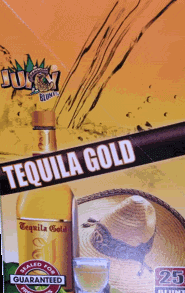
The reason is generally cited as these are aimed at children. But anybody familiar with the advertising and packaging of these products knows that they're clearly not. Here's a sample:


I've only seen one flavor that was arguably child friendly, and that was "purple." I can't find any information about it on the internet, but you'll have to take my word that there was a half naked girl on the package, again clearly not child aimed advertisements. I think a more useful ban would be on those candy cigarettes or something like that, or maybe reducing foreign chemical content in the cigarettes to make them harder to smoke and less child-friendly. This reaction is probably in part due to what people have been calling a reverse nicotine addiction that's way more prominent in urban areas. Here, people have observed that kids get addicted to cigarettes without smoking them, by getting addicted to the tobacco in blunts first and then cigarettes in turn. I can personally attest to this effect, but the flavor is not the catch. I think you'd find that the vast majority of buyers are partial to unflavored products anyway, especially initially.

Feral Hemp

I hadn't heard that phrase until I read this article from Talkleft.com but as it turns out the DEA spends 98% of their time with their heads up their asses. Just kidding, what actually is going on is the fact that they are eradicating feral hemp, or wild pot plants with little or no THC. Now, either they can't tell the difference or they're trying to prevent the public from realizing one thing, that cannabis is only a plant - not only a plant but a healthy, prolific, plant with lots of uses. Turns out Indiana seized 212 million plants by the DEA's count. So now we're not just the only country in the world that doesn't recognize industrial hemp as a legitimate crop, but we're also the only country that's trying to get rid of it - hemp, not pot. To compare that to real pot eradicated in that same year (2005), California counted only 2 million purposefully cultivated plants that were disposed of, the highest of any state. Ironically, the states with the highest number of what the DEA refers to as "ditchweed" generally tend to have lower cannabis consumption rates on average. To me, this seems like an attempt to keep the public ignorant about the plant and continue the stigmatization of its cultivation.

6.18.2009

Drugs Won The War, Now A Cancer

Big thanks to Mr. Brautigan, Mr. Weiner, Dr. Weitzner, Mr. Poeton, and Mr. Shainberg for making my morning a bit brighter. I somehow missed Nicolas D. Kristof's June 14th article Drugs Won The War. Their letters of support in favor of Kristof's argument made me truly happy to see that finally American citizens are standing up for this and are not afraid to voice their opinions on cannabis decriminalization / legalization / whatever, general drug prohibition reform. One of the writers is a physician discussing the simple health differences between alcohol and marijuana - while another is prosecutor with legal experience during the crack epidemic in Brooklyn making two excellent points about the chances of rehabilitating a criminal rather than someone that considers themselves a legitimate citizen and the wasted time and money spent by our military forces burning poppy fields in Afghanistan (not to mention that field is, unfortunately, some family's income). Another writer speaks to the parallel between the loss of power of the prohibition gangsters and a possible solution to the drug-cash fueled South American cartels and the Taliban. I find it interesting that the only letter published (now, I don't know how much of this is New York Times' spin - but hey, I'm not complaining, drug decriminalization never gets any positive spin) comes from Mr. Bob Weiner, the White House National Drug Policy Office spokesman from 1995 - 2001. Now, I don't dislike Bill Clinton at all, in fact I really like him, but he didn't do anything good for drug policy, that's for damn sure. Some of the points are pretty silly, he says that there seems to be a link to drugs and crime - no way that could have anything to do with the fact that drugs are illegal - and therefore now deeply rooted in our criminal culture? He also uses empty threats such as crack and cocaine use is down - "Want to go back?" Come on American politician and policy makers - I thought we were past these silly scare tactics. He threatens that hospital and emergency rooms would be flooded, and crime would return to crisis levels. This is ridiculous - it hasn't happened in any other country with lax drug policies - what makes him think it would happen here? There's nothing to suggest that decriminalization of cannabis would have any effect on the use of crack cocaine, would not increase violence, nor would it flood hospital emergency rooms. Mr. Weiner ends his statement saying that they are going to stop using the phrase war on drugs and instead use the word cancer, kind of a nonsensical solution but OK. If the government wants to really look at what kind of things are effective - I think it's safe to say these key phrases that they spend so much time coming up with are a huge waste of time. Whether you call it a war, a prohibition, or a cancer, the problem is not going to disappear or go into "remission" until policies, not catch-phrases, are changed.